Lesson 1.1: Understanding Canada’s Financial Institutions and Markets
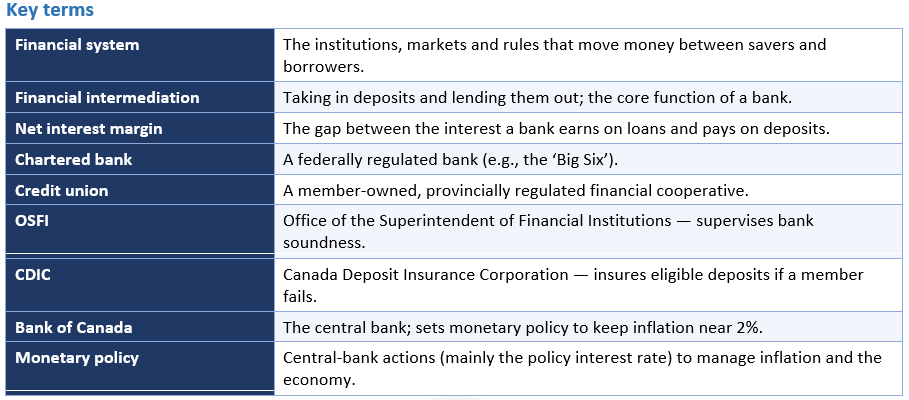
A financial system is the network of institutions, markets, rules and payment mechanisms that moves money from the people who have it (savers) to the people who need it (borrowers and businesses). When this system works well, a person’s paycheque can be deposited safely, a small business can borrow to expand, and a retiree can earn a return on savings; all at the same time. Understanding this flow of money is the foundation of every job in banking and financial services.
At the centre of the system are deposit-taking institutions. Chartered banks (the ‘Big Six’ — RBC, TD, Scotiabank, BMO, CIBC and National Bank — plus smaller banks) are federally regulated and offer the widest range of services. Credit unions and caisses populaires are member-owned cooperatives, regulated provincially, that often focus on local communities. Trust companies administer estates, trusts and some deposits. Alongside these sit insurance companies, which pool risk, and investment firms and dealers, which help people buy and sell securities such as stocks, bonds and mutual funds. Increasingly, financial technology (‘fintech’) companies provide digital payments, budgeting and lending services that compete with and partner with traditional institutions.
Banks make money chiefly through financial intermediation. They accept deposits (on which they pay a relatively low interest rate) and lend that money out as loans and mortgages (on which they charge a higher interest rate). The difference between the two rates is the net interest margin — a core source of bank profit. Banks also earn fee income from account services, credit cards, financial advice and wealth management. Because banks hold the public’s money and are central to the economy, they are among the most heavily regulated businesses in the country.
Canada has a tiered system of regulators and protections. The Office of the Superintendent of Financial Institutions (OSFI) supervises federally regulated banks and insurers to keep them financially sound. The Financial Consumer Agency of Canada (FCAC) protects consumers and enforces market-conduct rules; for example, rules about clear disclosure and complaint handling. The Canada Deposit Insurance Corporation (CDIC) insures eligible deposits at member institutions (up to defined limits) so that depositors do not lose their savings if a bank fails. Securities are regulated provincially (for example, by the Ontario Securities Commission), and self-regulatory bodies oversee investment dealers and mutual-fund dealers.
Sitting above the commercial system is the Bank of Canada, the country’s central bank. It is not a bank for the public; instead it is the ‘bank for the banks’ and the government. Its most visible job is monetary policy: it sets a benchmark interest rate (the policy or ‘overnight’ rate) to keep inflation low, stable and predictable the long-standing target is about 2% inflation. When inflation is too high, the Bank raises rates to cool spending and borrowing; when the economy is weak, it lowers rates to encourage activity. These decisions ripple through to the mortgage, loan and savings rates that customers see every day, which is why front-line staff must understand them. The Bank of Canada also issues the country’s bank notes and helps keep the payment system running.
Finally, the system depends on the payments and clearing infrastructure that settles the millions of transactions Canadians make daily; debit, cheques, direct deposits, pre-authorized payments, Interac e-Transfers and wire transfers. Payments Canada operates the core clearing and settlement systems that let money move safely between institutions. For a customer, all of this is invisible; for a financial-services professional, knowing how the pieces fit together is what makes you credible and useful.