
Lesson 2.2: Accounts, Cards & Borrowing Mechanics
Opening an account. Canadian rules give consumers a right to open a personal account at a bank with acceptable identification even without a job or an initial deposit. Staff verify identity with government-issued photo ID or an accepted combination of documents, record the details, and apply the institution’s newcomer or student packages where they fit. The conversation at opening, how the client gets paid, how they pay rent, whether they send money to family, is what turns a form into the right account.
How a credit-card month works. Purchases accumulate until the statement date; the client then has a grace period (at least 21 days in Canada) to pay the full balance before any interest is charged on those purchases. Pay in full and credit is effectively free; carry a balance and interest accrues on it at the card’s annual rate. Two traps to explain to clients: paying only the minimum payment keeps the account in good standing but lets interest compound, and cash advances earn interest from day one with no grace period at all.
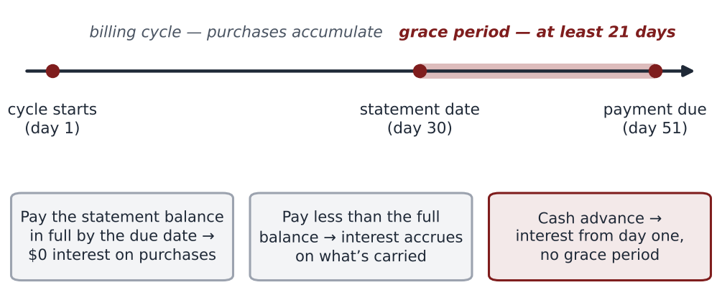
Figure 2.1 — A credit-card month: the grace period only protects a balance paid in full.
Instalment vs revolving credit. A personal loan or car loan is instalment credit: fixed amount, fixed schedule, done on the last payment. Credit cards and lines of credit are revolving: a limit the client can use, repay and use again. Lenders read them differently — a well-managed mix helps a credit file, while a maxed revolving limit is one of the loudest warning signs.
Mortgage anatomy. The amortization (often 25 years) is the total time to pay the loan off; the term (often 5 years) is the contract length before renewal at then-current rates. Rates come fixed (certainty) or variable (moves with prime). A buyer with less than a 20% down payment must buy mortgage default insurance (e.g., CMHC), which protects the lender, and all federally regulated lenders qualify applicants at a stress-tested rate higher than the contract rate, so clients can absorb increases. Front-line staff do not approve mortgages, but they book the appointments and set expectations.
Credit scores, from the ground up. Canadian scores run roughly 300–900 and live at two bureaus, Equifax and TransUnion. The heaviest factors: payment history (about a third of the score), credit utilization (keep balances under ~30% of limits), length of history, credit mix and recent inquiries. A newcomer with no file builds one fastest with a secured or starter card used lightly and paid in full, and a phone or utility plan in their own name. Checking one’s own report is a soft inquiry and never hurts the score.
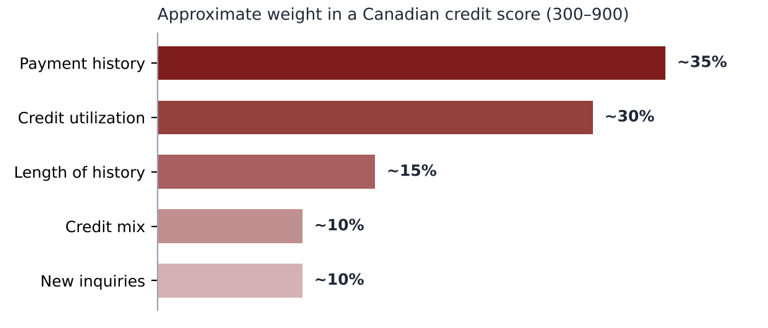
Figure 2.2 — What a credit score is made of (approximate weights).
Debt-service ratios. Lenders test affordability with GDS (housing costs ÷ gross income, guideline around 32%) and TDS (housing plus all other debt payments, around 40–44%). Example: $5,500 gross monthly income with $1,800 housing costs and a $450 car payment gives GDS 32.7% and TDS 40.9% — right at the edge, which is exactly the conversation a lender will want to have.
Self-check (answers below). 1. When does credit-card interest start on an ordinary purchase? 2. A client has a $6,000 limit, roughly what balance should they stay under, and why? 3. What is the difference between term and amortization?
Answers: 1 — only after the grace period, if the statement balance is not paid in full. 2 — about $1,800 (~30% utilization), a heavy scoring factor. 3 term is the current rate contract (e.g., 5 years); amortization is the full payoff period (e.g., 25 years).