Lesson 2.1: Everyday Banking & Deposit Accounts
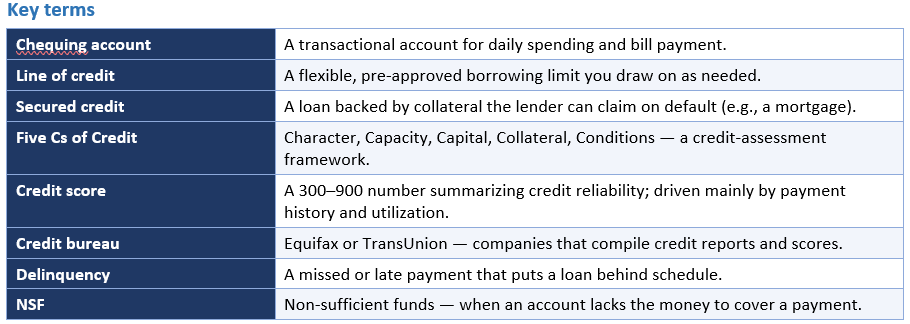
Most customers experience the financial system through everyday banking. The starting point is the deposit account. A chequing account is built for day-to-day transactions; paying bills, receiving a paycheque by direct deposit, and spending with a debit card; and usually pays little or no interest. A savings account is designed to hold money and earn interest, and may limit transactions. Registered accounts (covered on Day 3) add tax advantages. A front-line worker must be able to match the right account to a customer’s needs, explain the fees clearly, and open and service the account accurately.
Payments are how money actually moves. Debit cards draw directly from a chequing account. Credit cards borrow from the issuer and must be repaid, with interest charged on unpaid balances. Interac e-Transfers send money between people using email or a phone number. Pre-authorized debits automatically pay recurring bills, and direct deposit automatically receives pay or benefits. Wire transfers move larger amounts, often internationally. Understanding how each method works — and its cost, speed and risk — lets staff guide customers and spot problems such as fraud or non-sufficient funds (NSF).
Credit is the promise to repay borrowed money over time, and lending is one of a bank’s most important services. The main consumer credit products are personal loans (a fixed amount repaid in instalments), lines of credit (a flexible limit you draw on as needed), credit cards (revolving credit for everyday spending), and mortgages (large, long-term loans secured by a home). Each has its own interest rate, repayment structure and purpose. Secured credit (like a mortgage or car loan) is backed by an asset the lender can claim if the borrower defaults; unsecured credit (like most credit cards) is not, so it usually carries a higher interest rate.
Before granting credit, a lender assesses the risk that the borrower will not repay. A classic framework is the Five Cs of Credit: Character (the borrower’s track record and reliability), Capacity (income and ability to repay, often measured by debt-service ratios), Capital (the borrower’s own money or down payment), Collateral (assets securing the loan), and Conditions (the purpose of the loan and the economic environment). Lenders also pull a credit report and credit score.
A credit score is a three-digit number (in Canada, roughly 300–900) produced by credit bureaus (Equifax and TransUnion) that summarizes how reliably a person has used credit. It is driven mostly by payment history (paying on time) and credit utilization (how much of available credit is used), along with the length of credit history, the mix of credit types, and recent applications. A higher score means lower risk to the lender, which usually means easier approval and better interest rates. Front-line staff should be able to explain, in plain language, how customers can build and protect their score;
pay on time, keep balances low, and avoid too many applications at once.
Finally, lending involves documentation and responsibility. Loan agreements set out the amount, rate, term and payments; security documents register the lender’s claim on collateral. If payments are missed, the account becomes delinquent, and the institution follows a collections process. Responsible lending — lending only what a customer can reasonably repay and disclosing terms clearly — protects both the customer and the institution, and is reinforced by consumer-protection rules.