Lesson 3.1: Core Asset Classes & Investment Fundamentals
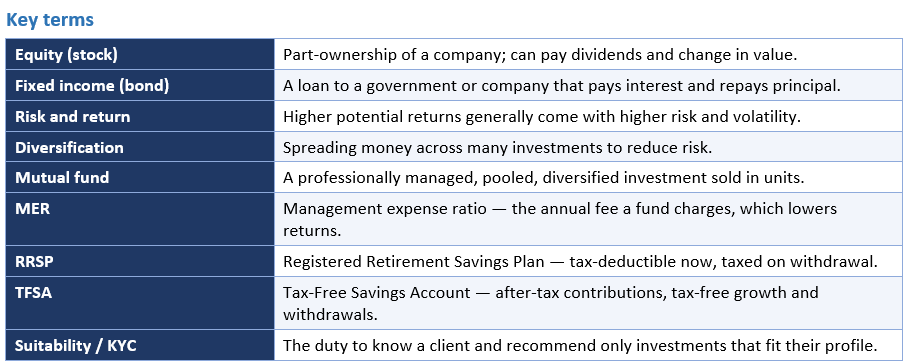
Beyond saving, customers invest to grow their money over time. Investing means putting money into assets that are expected to earn a return, accepting some risk in exchange for the chance of higher growth than a savings account provides. The core building blocks are equities (stocks), which represent part-ownership of a company and can pay dividends and rise (or fall) in value; fixed income (bonds), which are loans to a government or company that pay regular interest and return the principal at maturity; and cash equivalents like GICs (Guaranteed Investment Certificates), which are very safe but offer modest returns.
The relationship between risk and return is the central idea of investing. Generally, assets that offer higher potential returns also carry higher risk of loss and more short-term ups and downs (volatility). Cash is low-risk and low-return; bonds sit in the middle; stocks are higher-risk and higher potential return. Because no one can reliably predict markets, investors manage risk through diversification — spreading money across many investments so that a loss in one is cushioned by others. Time also matters: longer time horizons allow investors to ride out short-term swings.
For most everyday customers, the practical way to invest is through pooled products, especially mutual funds. A mutual fund collects money from many investors and a professional manager invests it in a diversified portfolio of stocks, bonds or both, according to the fund’s stated objective. Investors buy units of the fund and share in its gains, losses and income. Mutual funds make diversification and professional management accessible with relatively small amounts of money, but they charge fees — commonly expressed as a management expense ratio (MER) — that reduce returns, so understanding and disclosing fees is essential. Exchange-traded funds (ETFs) are a similar idea that trade on an exchange like a stock and often have lower fees.
In Canada, where you hold investments matters as much as what you hold, because of registered plans that carry tax advantages. An RRSP (Registered Retirement Savings Plan) lets you deduct contributions from taxable income now and defer tax until you withdraw in retirement, when income is often lower. A TFSA (Tax-Free Savings Account) is funded with after-tax money, but all growth and withdrawals are tax-free, making it flexible for many goals. An RESP (Registered Education Savings Plan) helps families save for a child’s education and can attract government grants. The newer FHSA (First Home Savings Account) helps first-time buyers save for a home with both a deduction and tax-free withdrawals. Each plan has contribution limits and rules, and choosing among them is a common customer conversation.
A critical professional duty attaches to all investment advice: suitability. Before recommending any investment, a representative must Know Your Client (KYC) — understand the customer’s goals, time horizon, income, net worth, investment knowledge and, above all, risk tolerance — and recommend only investments that fit that profile. Selling a high-risk product to someone who needs their money next year and cannot accept losses is both wrong and against the rules. Investment income is also taxed differently by type (interest, dividends and capital gains), which affects planning.
To work in this area, representatives typically complete industry courses and licensing. The Canadian Investment Funds Course (CIFC) or the Canadian Securities Course (CSC) provide the knowledge base; licensing to sell mutual funds or securities is obtained through the appropriate channels. This one-week course is a foundation that previews those pathways rather than a license itself.