


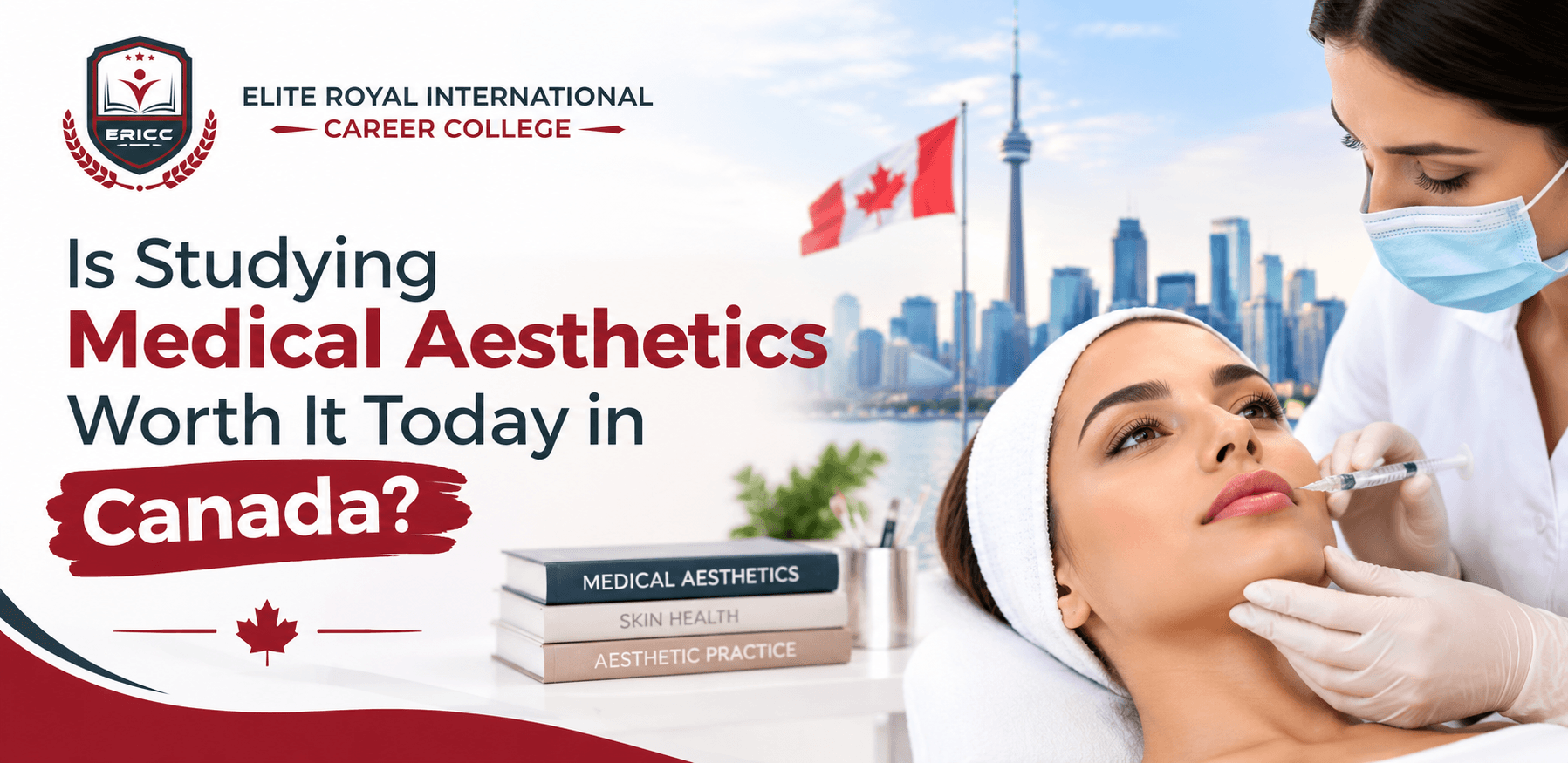
Skincare has moved from a spa treat to a real career path, and more people are asking whether a medical aesthetics program is a smart move. The answer depends on what you expect from it. This post covers wages, job outlook, admission requirements, and who the program suits, so you can decide with real numbers.
What is a medical aesthetics program?
A medical aesthetics program trains you to perform advanced, non-surgical skin and body treatments in settings like medical spas and skin clinics. It goes further than a standard esthetics course by adding the science behind the treatments.
At Elite Royal International Career College (ERICC), the Medical Aesthetics program runs 18 weeks (about 4 months). The modules cover:
- Skin science
- Skincare product formulations
- Laser fundamentals
- Body contouring
- Chemical peels and microdermabrasion
- Body treatments
- Introduction to injectables
- Interpersonal skills
- Consultative sales
- Medical spa operations
Notice the last two. Most of the job is talking to clients, recommending the right treatment, and running a clinic day. The treatment itself is only part of it.
How much does a medical aesthetician earn in Canada?
Ontario data comes from the government occupation group that includes estheticians and electrologists (NOC 63211). The Ontario wage range runs from $17.60 to $30.00 an hour, and the median is about $19.00.
If you worked full time all year at $19 an hour, that comes to roughly $39,500. But that is not how most people in this field work. Only 15% work all year, while 85% work part of the year, averaging 28 weeks. Real annual income depends heavily on how many treatments you book and how you are paid (hourly, commission, or booth rental).
Is there demand for medical aestheticians in Ontario?
Yes and no. Clients are still booking skincare and laser treatments, but the number of openings is small. Job Bank expects employment to stay relatively stable for 2025 to 2027, with few positions opening through retirement. That is a limited outlook, not a collapsing one.
One more figure matters here. About 51% of people in this occupation are self-employed, compared with 15% across all occupations. If you picture yourself renting a treatment room and building a loyal clientele, that is normal in this field. If you want a salaried job with benefits, search local postings before you enrol.
What are the admission requirements for a medical aesthetics program?
Requirements vary by school. At ERICC, applicants need one of the following for academic eligibility:
- A Canadian high school equivalency diploma (GED), or
- Foreign credentials translated into English and assessed for Grade 12 equivalency by a recognized body such as WES, or
- Mature student status, which may be granted to applicants over 19 without a Canadian high school diploma or GED
You also complete an entrance assessment: the Wonderlic SLE or another test approved by Ontario’s Ministry of Colleges and Universities.
English proficiency. If English isn’t your first language, you’ll need one of these:
|
Test |
Minimum score |
|
IELTS |
Average of 5.5 |
|
TOEFL iBT |
80 overall, at least 20 in each section |
|
CAEL |
60 overall, no section below 60 |
|
CELPIP |
7, no section below 6 |
|
Canadian Language Benchmark |
7 in each strand |
|
Duolingo English Test |
95 |
|
Pearson PTE Academic |
46 |
| NACC Written Entrance Exam |
60 |
Two years of full-time post-secondary study in English at a Canadian institution also satisfies the language requirement.
Placement requirements. Before the practical component, you’ll need a medical form completed by a physician, a Police Vulnerable Sector Check, and Standard First Aid with CPR Level C.
One detail to know: ERICC’s shorter certificate courses (electrolysis, chemical peel, laser hair removal, microdermabrasion) list an Aesthetics diploma as a prerequisite. Always confirm current requirements with the admissions team, since they can change.
Do you need a license to work in medical aesthetics in Ontario?
The industry isn’t provincially regulated the way nursing is. A diploma shows employers you’ve been trained, and some employers ask for extra certification on specific devices. However, some treatments, such as injectables and certain laser procedures, must be done under a regulated health professional. Before you plan a career around a particular treatment, check what you’re actually allowed to do on your own.
Medical aesthetics vs. esthetics: which one should you pick?
|
|
Esthetics |
Medical aesthetics |
|
Focus |
Facials, waxing, body treatments, spa services | Laser, peels, body contouring, clinical skin care |
|
Typical workplace |
Salons, spas |
Medical spas, skin clinics |
|
Science content |
Moderate |
Higher |
| Best for | Starting in beauty |
Building on an esthetics background or aiming for clinical settings |
If you’re new to the industry, ERICC’s Aesthetics program is the natural first step, and medical aesthetics can follow.
So, is it worth it?
I’d say yes in three situations. You want a short program and a fast start. You’re comfortable building a client base, because half the field is self-employed. Or you already work in beauty and want to add higher-value services.
I’d think harder if you expect a guaranteed salaried job right after graduation, or if you can’t afford a slow first year while your bookings grow. Program cost matters too, so ask for the full tuition and kit fees in writing and compare them against the wages above. Our funding assistance page explains the options.
Talk to our admissions team before you decide. They can walk you through start dates, fees, and placements for the Medical Aesthetics program.
FAQ
How long is a medical aesthetics program in Canada?
Length varies by school. ERICC’s program takes 18 weeks (about 4 months). Longer diplomas at other colleges can run a year or more.
Is medical aesthetics a good career in Canada?
It suits people who value hands-on work and independence. Ontario wages are modest (median about $19 an hour) and the three-year outlook is limited, so results depend on your specialization and client base.
Do I need a science background to apply?
No. Admission is based on high school equivalency, an entrance assessment, and English proficiency where needed. The program teaches skin science from the ground up.
Can I work as a medical aesthetician without a license in Ontario?
Yes for many treatments, since the field isn’t provincially regulated. Injectables and some laser procedures require supervision by a regulated health professional.
Can international students apply?
Yes. International applicants need credentials assessed for Grade 12 equivalency and proof of English proficiency.