


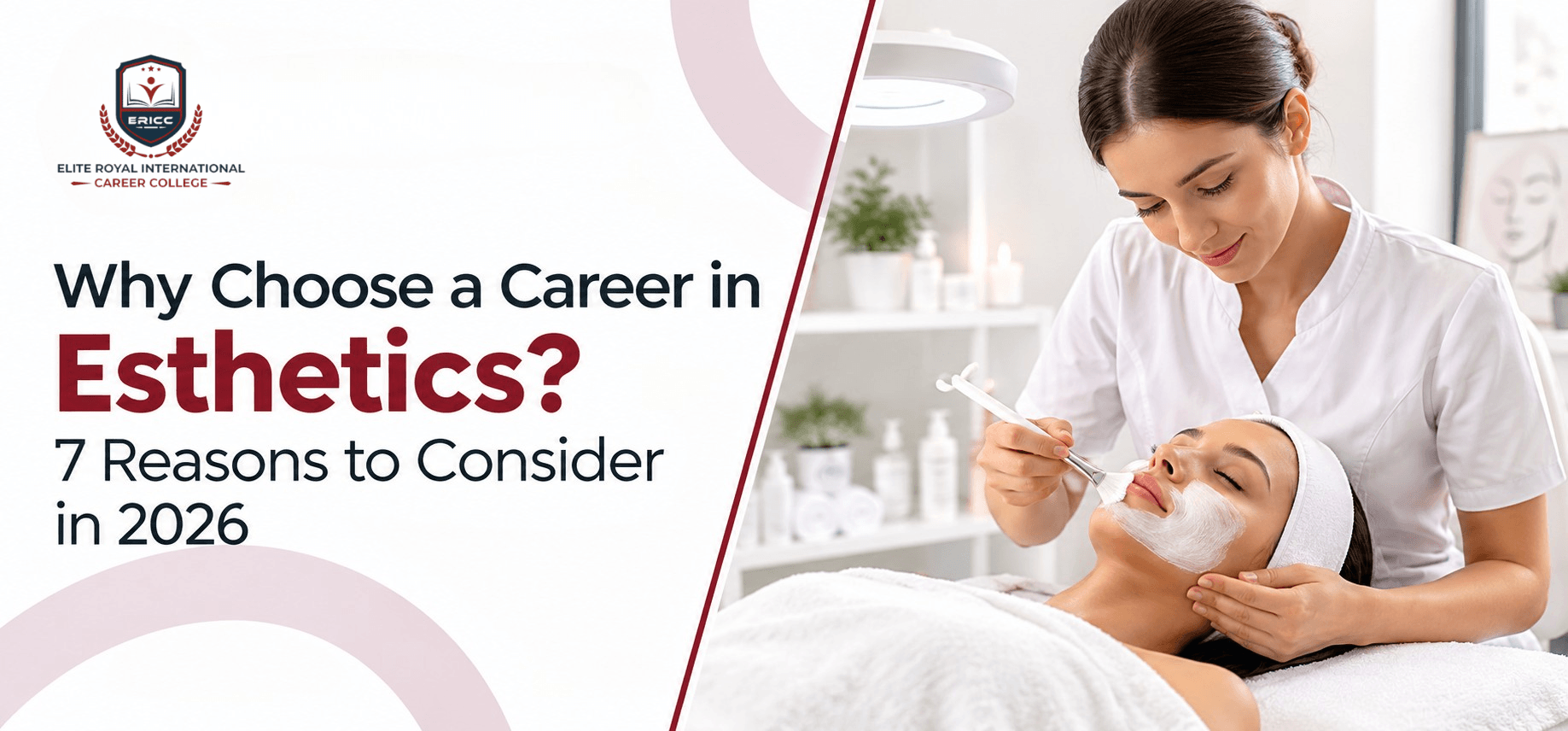
Skin care isn’t going anywhere. That’s the boring, practical reason a lot of people land on esthetics. But talk to anyone actually working the job and you’ll hear other things too: they like being on their feet, they like that clients come back, they like that the work changes hands-on daily instead of staring at a screen.
If you’re weighing this as a career, here’s what the job actually is, and seven reasons people keep choosing it in 2026.
What Is a Career in Esthetics?
An esthetician takes care of skin. Sometimes hair removal too, sometimes makeup, sometimes body treatments, depending on the program and the workplace. Facials. Chemical exfoliation. Waxing. Brow and lash work. Telling a client, honestly, that the product they’re using isn’t right for their skin type.
It’s a trade, and in most of Canada it leans on real science, not just technique. You’re learning skin anatomy, infection control, product chemistry, alongside the hands-on parts. Some estheticians end up in medical or dermatology settings doing more advanced work. Others build a loyal client base at a salon. A fair number eventually open something of their own.
Our Aesthetics Program lays out what’s covered module by module, from skin care basics through business and retail management, if you want to see the whole path before committing to anything.
What You Actually Get Out of It
A few practical things worth naming up front:
- You can be working within a year or two, not after a four-year degree.
- Pay comes from services, retail, and tips, and it tends to climb as your client list grows.
- The demand doesn’t disappear when the economy dips. People still get haircuts and facials.
- Once you have experience, you get real say over your schedule, which is rarer than it sounds.
- You don’t need to buy equipment or rent space to start working for someone else.
7 Reasons to Consider an Esthetics Career in 2026
1. You learn by doing it, not by reading about it
A lot of careers make you sit through years of theory before you’re allowed near real work. Esthetics training doesn’t really work that way. You’re on clinic floors doing facials and waxing on real skin fairly early, which means by graduation you’ve already done the job. You’re not translating a textbook into practice for the first time on someone’s face.
2. The relationships are real, and they repeat
Clients come back. Sometimes for years. You start recognizing their skin, remembering what worked last time and what didn’t. That kind of repeat contact isn’t common in a lot of entry-level service jobs, and it’s a big part of why referrals happen and why some estheticians eventually build a business off word of mouth alone.
3. No day looks exactly like the last one
A facial in the morning, an acne consult after lunch, a full brow-and-lash appointment before someone’s wedding. It keeps the work from going stale, and it forces you to keep learning, since skin problems and client goals are never quite identical twice.
4. It’s not one job, it’s several
“Esthetician” covers a lot of ground. Medical esthetics alongside dermatologists. Makeup artistry. Hair removal specialization. Teaching the next class of students. Running your own spa. Depending on where your training and interests take you, you can shift lanes later without starting from zero.
5. The flexible-schedule thing is actually true here
Because clients book appointments instead of you clocking a fixed shift, experienced estheticians often get real control over their hours, day, evening, weekend, part-time, full-time. Useful if you’re balancing school or another job while training. Even more useful once you’re working.
6. Canada’s data backs up the demand
Roughly 71,300 people were working as estheticians nationally as of 2023, and Canada’s Job Bank projects labour demand and supply to stay broadly balanced for the occupation through 2033. That’s not explosive growth, but it’s stability, and stability matters when you’re choosing something to build a career on rather than chase a trend. You can check the current numbers yourself on Canada’s Job Bank. jobbankjobbank
7. You don’t need experience to start
No background in beauty or medicine required. Programs are built for people starting from zero, with foundational skills first. What actually matters more is genuine interest in skin care and decent English communication, especially in Ontario programs. Our Admission Requirements page has the specifics, credentials, English proficiency options, mature student routes, if you want to check where you stand before applying.
Is This the Right Fit for You?
If you like working with people and don’t mind being on your feet all day, this is worth a serious look. It rewards patience and attention to detail more than raw talent. It’s probably not for you if you’d rather work alone, or if repeating the same technique correctly, over and over, sounds tedious rather than satisfying. For the right person, though, it’s a career with real room to grow.
FAQ
Do I need prior beauty or medical experience to enroll?
No. Programs start with foundational skills. An interest in skincare and solid communication matter more than a resume.
Do I need a license to work as an esthetician in Ontario?
There’s no mandatory provincial license, though employers tend to prefer accredited training, and you’ll still need to follow hygiene and infection control standards.
How long does training take?
Depends on the program. Short certificate courses in one skill, like lash artistry, or longer diploma tracks covering skin care, body treatments, and business together.
Can estheticians eventually work for themselves?
Yes, and it happens often. That’s part of why business and retail management gets built into full esthetics programs in the first place.