


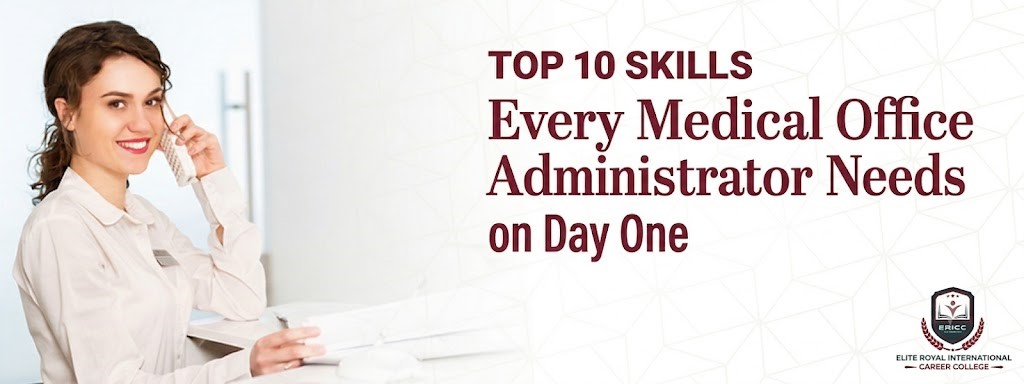
A Medical Office Administrator (MOA) is usually the first person a patient talks to and the last person a doctor relies on to keep a clinic running on schedule. The role sits at the intersection of healthcare, customer service, and office management which means a strong MOA needs a wider skill set than the job title suggests.
If you’re considering this career path or about to start your first week on the job, here are the ten skills that matter most from day one.
1. Electronic Medical Records (EMR) Software Proficiency
Almost every clinic, hospital, and private practice in Ontario now runs on electronic medical records systems such as OSCAR, Accuro, or PS Suite. A Medical Office Administrator needs to confidently:
- Enter and update patient records accurately
- Schedule appointments within the EMR calendar
- Pull up patient history during a call without delay
- Flag duplicate or incomplete records
Employers rarely have time to train this from scratch, so hands-on EMR practice before your first day is one of the highest-value skills you can walk in with.
2. Medical Terminology
You don’t need to diagnose anything, but you do need to understand what’s being said and written around you. MOAs regularly read requisitions, transcribe physician notes, and process insurance forms all filled with clinical shorthand and terminology. Misreading a term like “bilateral” or “STAT” can cause real scheduling or billing errors.
3. Patient Communication and Front-Desk Etiquette
Patients calling a clinic are often anxious, in pain, or frustrated by wait times. A Medical Office Administrator needs to:
- Stay calm and professional under pressure
- Communicate clearly with patients of different ages, languages, and comfort levels
- De-escalate frustrated callers without sounding scripted
- Know when to escalate a concern to clinical staff
This is consistently the skill employers say new hires are weakest in not because it’s hard to learn, but because it’s hard to practice without real patient interaction.
4. Scheduling and Time Management
A single physician’s day might involve dozens of overlapping appointments, walk-ins, lab results, and callback requests. MOAs are responsible for building a schedule that doesn’t fall apart by 10 a.m. This means understanding:
- Appointment-type durations (a physical takes longer than a prescription renewal)
- Buffer time for emergencies and overruns
- How to triage same-day requests
5. Medical Billing and Insurance Processing
In Ontario, this means working with OHIP billing codes, as well as private insurance and third-party claims for services OHIP doesn’t cover. Billing errors directly affect a clinic’s revenue, so accuracy here isn’t optional. New MOAs should be comfortable with:
- OHIP billing codes relevant to the practice type
- Submitting and tracking claims
- Resolving rejected or incomplete claims
6. Confidentiality and Privacy Compliance
Every patient record an MOA touches is protected under Ontario’s Personal Health Information Protection Act (PHIPA). This isn’t a “nice to have” — it’s a legal requirement woven into nearly every task: faxing a referral, answering a phone call within earshot of the waiting room, or sending records to another provider. A well-trained MOA understands PHIPA basics before they ever handle a real patient file.
7. Multitasking Under Pressure
Phones ringing, patients checking in, a fax coming through, and a physician asking for a file — often all within the same two minutes. The administrators who thrive in this environment aren’t the ones who panic less; they’re the ones who’ve built systems for prioritizing tasks instinctively. This is a skill that improves dramatically with structured practice, which is why simulated front-desk scenarios are so valuable in training.
8. Written Communication
MOAs draft referral letters, respond to patient emails, and document notes that other staff will rely on later. Clear, professional, error-free writing matters more in healthcare than almost any other administrative setting, since a miscommunication can affect patient care.
9. Basic Office and Tech Skills
Beyond EMR systems, MOAs are expected to handle:
- Microsoft Office (Word, Excel, Outlook)
- Multi-line phone systems
- Fax and scanning equipment
- Basic troubleshooting when software or hardware acts up
10. Adaptability
No two days look the same in a medical office. A flu season surge, a doctor running late, a system outage during flu shot clinics the administrators who succeed are the ones who can adjust on the fly without losing accuracy or composure.
How Much Do Medical Office Administrators Earn in Ontario?
According to the Government of Canada Job Bank, medical administrative assistants in Ontario typically earn between $17.60 and $32.70 per hour, with the higher end reflecting experience, specialization, and location. Private-sector recruiting data tells a similar story: Robert Half’s 2026 salary guide for Toronto places Medical Office Administrator pay from roughly $50,300 at entry level to about $66,750 for highly experienced candidates with specialized certifications.
Pay varies by clinic type, specialty, and region, but the trend is consistent: the more of the ten skills above you walk in with, the faster you move toward the higher end of that range.
How ERICC Builds These Skills Before Day One
Elite Royal International Career College’s Medical Office Administration program is designed around the exact gap most new hires struggle with: the difference between knowing the theory and being ready to perform under real clinic conditions. The program combines:
- Hands-on EMR software training
- Medical terminology and anatomy fundamentals
- OHIP billing and insurance claims practice
- Front-desk simulation exercises for patient communication
- A field placement at a real healthcare facility, where these skills get tested in practice
If you’re exploring a career as a Medical Office Administrator in the Greater Toronto Area, the program is built to get you from classroom to confident on the job.
Learn more about the Medical Office Administration Program
or
book a free consultation to see if it’s the right fit for you.
Frequently Asked Questions
What is the most important skill for a Medical Office Administrator?
Patient communication and EMR software proficiency are typically the two skills employers prioritize most, since they affect both the patient experience and daily clinic operations from the first shift.
Do Medical Office Administrators need medical training?
No clinical training is required, but a solid grasp of medical terminology is essential for reading physician notes, requisitions, and patient files accurately.
How long does it take to become a Medical Office Administrator in Ontario?
Career college programs, like ERICC’s, are typically structured to be completed in under a year, significantly faster than a college diploma route, while still including a field placement component.